Cybersecurity keeps expanding because the digital systems organizations depend on are getting more interconnected, more identity-driven, and harder to defend consistently, while attackers evolve tactics around ransomware, social engineering, and disruption.
This explainer updates the “why” behind industry growth and gives an intermediate-friendly way to map roles, skills, and realistic paths into (or within) cybersecurity—without salesy promises or vague advice.
Quick take
- Growth isn’t just “more attacks.” It’s more complexity: cloud, SaaS sprawl, identity everywhere, supply chains, and faster change.
- Demand is strongly influenced by skills gaps: in 2024 ISC2 estimated a global workforce gap of 4,763,963 people.
- Many organizations report skills shortages as a barrier to resilience; WEF’s Global Cybersecurity Outlook 2025 notes two in three organizations reporting moderate-to-critical skills gaps and only 14% confident they have the talent they need.
- Cybersecurity careers are not “one job”; use role frameworks (like NICE) to pick a path and build targeted skills.
Dominant search intent (what readers actually want)
Most readers want clarity on two questions: (1) what forces are making cybersecurity grow, and (2) what roles and skills are worth investing in so they can navigate the field strategically.
What’s driving cybersecurity’s expansion
1) Attacks are diversifying: disruption, extortion, and data exposure
Modern cyber risk isn’t one category; it includes disruption (availability), extortion (ransomware), and data-focused threats, which keeps the defensive surface area broad.
ENISA’s Threat Landscape 2024 highlights “threats against availability,” ransomware, and threats against data among the prime threat areas it tracks.
2) Identity is the new perimeter (and attackers know it)
As organizations adopt cloud and SaaS, identities and access paths become the critical control plane—so credential theft, phishing, and access misuse drive day-to-day defense priorities.
Microsoft’s Digital Defense Report 2024 is structured around modern threat realities including identity and social engineering, ransomware, and DDoS, reflecting how defensive work spans multiple attack classes.
3) AI raises both the ceiling (defense) and the floor (attacks)
AI doesn’t “replace cybersecurity”; it changes it by accelerating both attacker experimentation and defender tooling, while increasing the premium on skilled humans who can validate, tune, and govern defenses.
ENISA notes that AI-driven phishing and deepfake campaigns are growing in sophistication, which expands the need for detection, training, incident handling, and verification workflows.
WEF’s Global Cybersecurity Outlook 2025 also connects AI adoption to new vulnerabilities and emphasizes the widening cyber skills gap as a compounding factor.
4) The skills gap is real (and it shapes hiring)
Even when budgets fluctuate, many organizations report that they don’t have enough people with the right skills mix, which pushes demand toward practical, role-aligned capability.
ISC2’s 2024 study estimates a global workforce gap of 4,763,963 cybersecurity professionals and describes how skills gaps affect organizations’ ability to secure themselves.
5) Regulation and resilience expectations create “must-do” work
Security is increasingly treated as a business requirement (risk, uptime, reporting, supplier controls), which creates ongoing work in governance, assurance, monitoring, and incident readiness.
How to verify in your context: review your industry’s regulator guidance and customer security questionnaires, then map recurring obligations into roles (GRC, security engineering, incident response).
What cybersecurity work actually looks like (role map you can use)
If you’re planning a career move—or hiring—avoid the trap of “learn cybersecurity.” Instead, choose a job family and build depth.
The NIST NICE Workforce Framework for Cybersecurity is useful because it standardizes how organizations describe cybersecurity work roles and helps with recruiting and development.
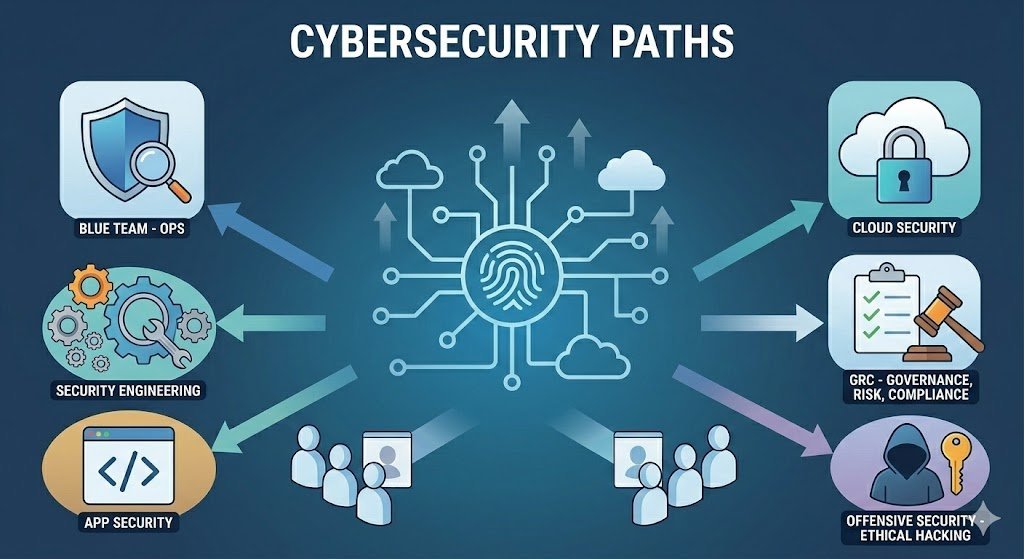
Common job families (high-level)
- Security operations (Blue team): monitoring, triage, detection engineering, incident response.
- Security engineering: identity, endpoint, network, email security, hardening, platform controls.
- Application security: secure SDLC, code review support, threat modeling, vulnerability management.
- Cloud security: IAM, posture management, logging, workload protection, secure architecture.
- GRC: policy, risk, audits, vendor/security questionnaires, control testing.
- Offensive security: penetration testing, red teaming (typically later-stage specialization).
Career reality check (what to expect)
Compensation and job outlook (avoid blanket claims)
Pay and job availability vary by country, sector, and seniority, so avoid treating any single stat as universal.
As one concrete benchmark, the U.S. Bureau of Labor Statistics reports a median annual wage of $124,910 (May 2024) for information security analysts and projects 29% employment growth from 2024 to 2034.
How to verify locally: compare your region’s job boards, salary surveys, and employer role descriptions for the same role family (SOC, cloud security, AppSec, GRC).
When cybersecurity might NOT be the right move
- If you dislike ambiguity and rapid change, some security roles can feel like “permanent incident season.”
- If you want deep building with minimal interruption, consider security engineering or AppSec rather than pure incident response.
- If you want predictable tasks and minimal after-hours work, be selective about roles that include on-call rotations.
How to pick a cybersecurity path (decision tree)
START | |-- Do you like fast triage + puzzles under time pressure? | |-- Yes --> SOC / Detection / Incident Response | '-- No | |-- Do you like building guardrails and platforms? | |-- Yes --> Security Engineering / Cloud Security | '-- No | |-- Do you like process, evidence, and reducing risk via controls? | |-- Yes --> GRC / Risk / Compliance | '-- No | '--> Explore AppSec (if you like dev workflows) or threat intel (if you like research)
A practical 90-day plan (intermediate level)
- Weeks 1–2: Choose one job family, write a skills inventory, and pick 2–3 gaps to close (not 12).
- Weeks 3–6: Build a portfolio artifact that proves competence (detections, hardening baseline, cloud logging pipeline, threat model).
- Weeks 7–10: Operationalize: write runbooks, add monitoring, and document trade-offs (what you didn’t do and why).
- Weeks 11–13: Interview prep: convert your artifact into a 5-minute walkthrough and a 1-page diagram.
Troubleshooting (common blockers)
“I’m learning, but I don’t feel employable.”
Fix: stop collecting topics and start producing artifacts tied to a role family (e.g., a detection + triage runbook; a cloud logging blueprint; a vendor risk questionnaire playbook).
“I can’t decide between cloud security and SOC.”
Fix: run two small experiments: (1) build a logging+alert pipeline in a lab, (2) do a week of alert triage exercises; choose what you’d do repeatedly without burning out.
“AI makes this feel pointless.”
Fix: treat AI as a productivity layer and governance problem, not a replacement; ENISA’s threat landscape explicitly calls out AI-driven phishing/deepfake sophistication, which increases the need for verification and response workflows.
FAQ
Is cybersecurity still “growing,” or is it hype?
Growth signals show up as persistent skills gaps and expanding threat categories; ISC2’s workforce gap estimate and WEF’s skills-gap findings both point to ongoing demand pressures.
What’s the best first specialization for someone with IT experience?
Common transitions are into security engineering (identity, endpoint, email) or SOC/detection; pick based on whether you prefer building controls or investigating incidents.
Do I need a degree?
A degree can help, but many roles still prioritize demonstrable skill; build a portfolio artifact aligned to the NICE-style role language employers use.
Is “ethical hacking” the main path into cybersecurity?
No—offensive roles exist, but many organisations hire more heavily for defence, engineering, and governance; choose based on your strengths and local demand.
What’s changing fastest right now?
AI-accelerated social engineering and threat diversity are shifting day-to-day defense work; both ENISA and Microsoft’s 2024 report structure reflect these changes.
Where can I read current, credible threat trends without hype?
Start with ENISA’s Threat Landscape 2024 publication and Microsoft’s 2024 Digital Defense Report for practitioner-oriented coverage.
Key takeaways
- Cybersecurity expands because complexity expands: identity, cloud, suppliers, AI-era social engineering, and disruption risks.
- Stop thinking “cybersecurity job” and start thinking “role family + artifacts,” using frameworks like NICE to choose a path.
- Verify career claims locally; use reputable benchmarks and job descriptions, not generic promises.
Further reading (one high-signal report): If you want a board-level view of complexity and skills gaps, review the World Economic Forum’s Global Cybersecurity Outlook 2025.

💬 Comments