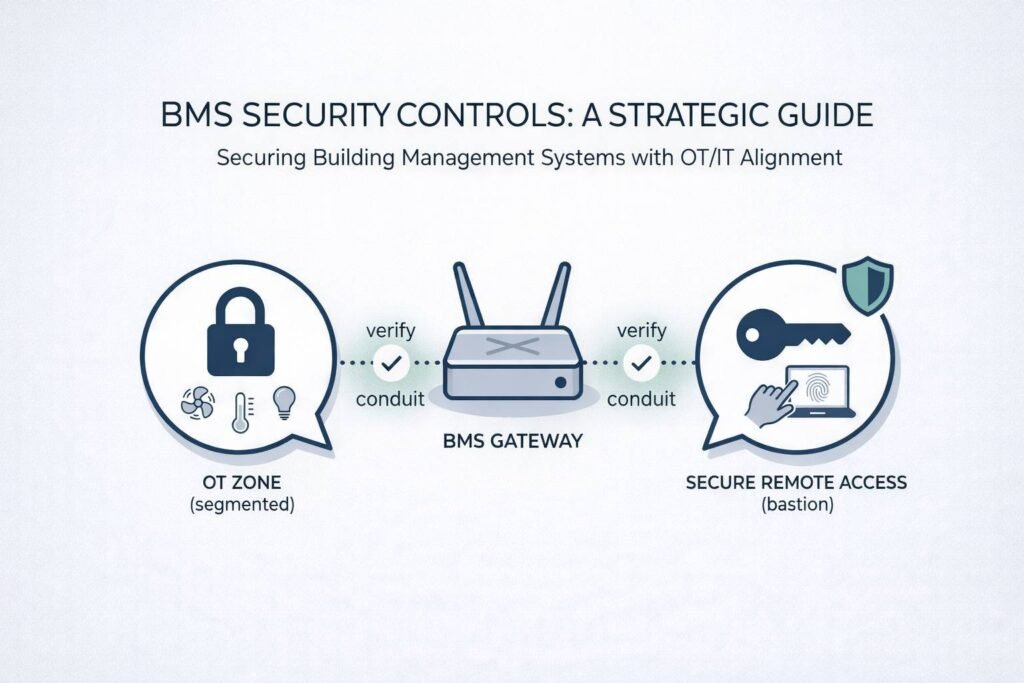
Building management systems sit at the intersection of OT reliability and IT connectivity, which makes “standard IT hardening” necessary but not sufficient. This guide focuses on the controls that actually reduce risk in BMS/BAS environments without breaking uptime, safety, or vendor support.
Quick take: Most BMS compromises happen through weak remote access, flat networks, unmanaged credentials, and blind spots in monitoring—so start with segmentation, identity, and remote access design, then mature into continuous assessment and response.
1) Start with a BMS threat model (not a buzzword)
Before you change anything, document what “bad” looks like for your site: loss of HVAC control, safety impacts, tenant disruption, equipment damage, or a pivot into corporate IT. NIST’s ICS security guidance is a useful baseline for thinking about OT threats, constraints, and architectures without assuming your environment behaves like office IT.
Define these three items in writing:
- Critical functions: What must stay up (e.g., ventilation, chilled water loops, smoke control integration).
- High-risk pathways: Remote access, vendor connections, BMS workstations, and any bridges to IT.
- Failure tolerance: What can be patched/rebooted during business hours vs maintenance windows.
2) Segment the BMS like OT: zones, conduits, and “deny by default”
The fastest way to reduce blast radius is to stop treating the BMS as “just another VLAN” and instead design segments with explicit allowed flows between them. NIST SP 800-82 recommends network segregation practices and architectures that map well to BMS environments (even when you can’t redesign everything at once).
A practical segmentation model that works in many buildings:
- BMS management zone: engineering workstation(s), supervisors, management servers.
- Control zone: controllers, field panels, gateways.
- Integration/DMZ zone: historians, data export brokers, API gateways (if needed).
- Remote access zone: jump host / bastion, VPN termination, vendor entry point.
- Enterprise IT zone: user desktops, business apps (kept separate from control traffic).
Implementation notes (what practitioners learn the hard way):
- Use layer-3 boundaries plus firewall policy for enforcement; VLANs help with grouping, but they don’t enforce “who can talk to what” by themselves.
- Write allowlists based on known services and ports, then monitor exceptions; don’t start from “allow any” and hope to tighten later.
- Make vendor support part of the plan: capture current comms patterns before you restrict them, and test changes in a maintenance window.
3) Remote access: design it as an intrusion pathway
Remote access is often the highest-leverage attack path because it’s intentionally exposed to untrusted networks. The joint NSA–CISA guidance on selecting and hardening remote access VPNs is a solid baseline: treat VPNs as high-value entry points, restrict administrative access, log activity, and segment what remote users can reach.
Minimum viable “secure remote access” for BMS:
- No direct access to controllers from the internet: terminate remote access in a dedicated zone, then hop inward with explicit approvals.
- Use a jump host: remote users reach a hardened bastion; the bastion is the only system allowed to initiate management sessions into BMS zones.
- Separate admin planes: do not expose management interfaces broadly; keep them on internal management networks where possible.
- Log the right events: authentication, session start/stop, privilege elevation, configuration changes, and unusual connection attempts.
When not to use “always-on vendor tunnels”: if you can’t monitor or constrain them, you’re effectively delegating part of your building’s security boundary to someone else. Use time-bound access (approved window + scoped target) whenever your tooling and contracts allow it.
4) Identity and credentials: eliminate shared access in the real world
In BMS environments, shared credentials and default passwords persist because they’re “convenient” during commissioning—and then remain forever. Use CISA’s Cross-Sector Cybersecurity Performance Goals as a practical way to prioritize foundational identity and access controls across both IT and OT stakeholders.
What to implement (practical and enforceable):
- Unique named accounts for anyone who can change logic, setpoints, schedules, or alarm routing.
- Privileged access separation: day-to-day accounts are not admin accounts.
- Credential lifecycle: onboarding requires approval; offboarding removes badges, VPN, BMS accounts, vendor portal access, and saved credentials on jump hosts.
- Stored credential hygiene: if you use a vault, test “break glass” access and ensure it’s audited (don’t just buy tooling).
5) Protocol reality: understand BACnet risk, then modernize deliberately
Many building environments still rely on legacy assumptions: “It’s on a building network, so it’s safe.” If your site uses BACnet, modernization may include BACnet Secure Connect (BACnet/SC), which is designed to provide secure transport using TLS and certificate-based trust. ASHRAE’s BACnet/SC whitepaper explains the security goals and the design at a high level.
Trade-offs to consider before you push for BACnet/SC:
- Certificate operations: you’re adding a PKI-like lifecycle (issuance, rotation, revocation), so assign ownership.
- Mixed estates: most sites will run a hybrid of legacy BACnet and newer secure segments; plan gateways and segmentation accordingly.
- Vendor maturity: verify your specific controller/supervisor support and interoperability in a lab or pilot floor before full rollout.
How to verify on your site: request your integrator’s exact part numbers/firmware, then confirm protocol support and security modes in the vendor’s commissioning guide for that version.
6) Patch and vulnerability management without breaking the building
In BMS/OT, patching is constrained by uptime, certification, and vendor dependencies—so build a process instead of “patch everything immediately.” NIST’s ICS guidance emphasizes tailoring risk management and recommended practices to the operational constraints of control environments.
- Inventory first: maintain an asset list of supervisors, workstations, controllers, gateways, remote access components, and integrations.
- Classify impact: “can reboot anytime,” “maintenance window only,” “never reboot during winter peak,” etc.
- Test path: lab or staging for updates that touch controllers and supervisors; document rollback steps.
- Compensating controls: when you can’t patch, tighten segmentation, restrict remote access, and increase monitoring around the fragile component.
7) Monitoring and logging: focus on the choke points
You don’t need perfect telemetry on every field device to get meaningful detection—start with the places where compromise is most visible and actionable. The NSA–CISA VPN guidance highlights the importance of logging and monitoring remote access activity, which is typically one of the most valuable signal sources in BMS environments.
High-value monitoring points:
- Remote access: VPN/bastion authentication logs, session logs, admin actions.
- Perimeter between zones: firewall allow/deny events, new flows, policy changes.
- BMS management hosts: new services, unexpected outbound connections, new local admins.
Troubleshooting tip: if segmentation “breaks BACnet,” capture the original traffic pattern first, then re-allow only the minimum flows needed—otherwise you’ll end up re-opening everything under pressure.
Organizations that want deeper visibility across OT networks sometimes deploy specialized monitoring platforms from an OT security vendor designed to detect anomalies and asset risks in industrial control environments without disrupting operations.
8) Incident response for BMS: make the first 30 minutes safe
IT incident response playbooks often fail in buildings because “pull the plug” can create safety and operational problems. Use NIST’s OT/ICS framing to create a BMS-specific plan that prioritizes containment while preserving safe operations.
Include these BMS-specific playbooks:
- Remote access containment: disable vendor tunnels/VPN accounts first; rotate credentials used on the jump host.
- Segmentation escalation: pre-approved “restrictive firewall profile” you can apply quickly.
- Restore priorities: what must come back first (alarms, monitoring, then control), and who can authorize changes.
- Forensics constraints: what you can image/log without disrupting controllers.
Operationalize it with the CISA CPG checklist as a task tracker for foundational readiness items you can measure over time.
Implementation checklist (printable)
- Document BMS zones and allowed conduits (include remote access path).
- Move remote access behind a bastion; restrict reachability to explicit targets.
- Eliminate shared/default credentials; enforce privileged access separation.
- Build an asset inventory and patch workflow tied to maintenance windows.
- Centralize logs from VPN/bastion and zone firewalls; review routinely.
- Run one tabletop exercise for a BMS intrusion scenario; update playbooks.
Decision tree: what should you do first?
If BMS is reachable from the public internet: - Remove exposure immediately (then rebuild remote access safely)
Else if vendors have always-on tunnels you can't monitor: - Replace with time-bound access + bastion + logging
Else if BMS network is flat (everything talks to everything): - Segment into zones + firewall policy between zones
Else: - Mature identity, patch workflows, and detection at choke points
FAQ
Is “air-gapping” a realistic recommendation for modern BMS?
Sometimes, but only for specific high-risk zones where you can still maintain the system safely and meet operational requirements. In most buildings, engineered segmentation and tightly controlled conduits provide a more maintainable security outcome than a blanket disconnect approach.
Are VLANs enough to isolate my BMS?
VLANs help with logical grouping, but they do not automatically enforce security policy between groups. Use firewalls and explicit allowlists between zones to enforce restricted data flow in a way that is more aligned with OT security architecture guidance.
What’s the safest way to give vendors access?
Use a dedicated remote access zone with a bastion/jump host, time-bound approvals, and full session logging. Treat the VPN and remote entry components as high-value targets and harden/monitor them accordingly.
Should I migrate to BACnet/SC right now?
If you’re designing a new system or major refresh, BACnet/SC can reduce exposure by adding TLS-based secure transport and certificate trust—but it also adds certificate operations and compatibility planning. Start with a pilot segment and confirm support for your exact devices and versions before committing.
How do I align BMS security with recognized standards without boiling the ocean?
Use IEC 62443 concepts (zones/conduits; foundational requirements) to structure architecture and procurement requirements, then execute in phases. An ISASecure overview shows how IEC 62443 can be applied to building management systems without assuming a “one size fits all” implementation.
What’s one control that gives the biggest risk reduction per hour spent?
Remove direct exposure, then lock down remote access pathways (bastion + scoped access + logging) because they are frequent intrusion paths and are operationally manageable to improve.
Final note
BMS security is not a single product—it’s an operating model: segmentation, controlled remote access, credential discipline, and a response plan that respects building safety. If you only do one thing this quarter, make remote access and segmentation provably safer and easier to audit.

💬 Comments