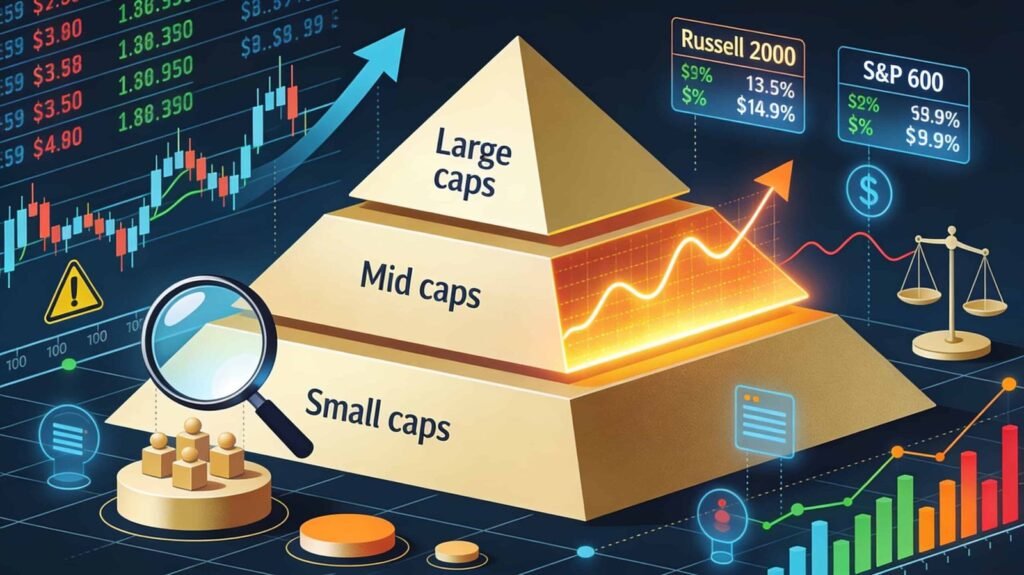
Small-cap stocks are shares of public companies with relatively smaller market capitalization (market cap), meaning the total market value of all outstanding shares. Market cap is commonly described as the value of publicly traded shares plus restricted shares held by insiders/officers.
The key point: “small-cap” has no single universal dollar cutoff—providers define it using either approximate ranges or market-percentile breakpoints that shift over time.
How small-cap is defined (2026 reality)
There are two mainstream ways you’ll see “small-cap” defined:
- Dollar-range definitions (simple, approximate)
Investopedia describes a small-cap stock as a public company with market capitalization of about $250 million to $2 billion. - Percentile/breakpoint definitions (what many indices actually do)
Morningstar uses a flexible system: large caps are the top 70% of total market capitalization in its domestic universe, mid caps are the next 20%, and small caps are the remaining segment (rather than a fixed dollar range).
For Russell indexes, small caps are determined by ranking and a moving breakpoint between the Russell 1000 and Russell 2000; FTSE Russell notes the breakpoint can shift significantly over time (for example, citing a 2021 breakpoint of $5.2 billion).
Why this matters: a “$3B company” could be labeled small-cap by one index methodology and mid-cap by another, so always check the classification source you’re using.
Common market-cap buckets (use as rough orientation, not gospel)
Many educational resources still teach a tiering system (mega/large/mid/small/micro), but treat any fixed numbers as context, not a standard. If you want a durable reference point, it’s often better to anchor your definition to an index methodology (Russell 2000, S&P SmallCap 600) or a provider (Morningstar) rather than a static dollar range.
“Examples” that don’t go stale: use indices, not a stock list
Instead of naming “famous small-cap stocks right now” (which breaks the moment prices move), use these durable anchors:
- Russell 2000: commonly referenced as a small-cap benchmark index.
- S&P SmallCap 600: a smaller, curated U.S. small-cap index; a public reference notes its median market cap was $2.06 billion as of Dec. 31, 2024.
If your goal is to understand the typical size of companies you’ll hold, a public explainer reports the Russell 2000’s median market cap was $987 million at the end of 2024 (citing FTSE Russell).
Why investors consider small caps (and what the trade-off really is)
Small caps are often associated with higher growth potential because smaller businesses can scale revenue faster from a smaller base, but that potential comes with meaningful risks. Small company stocks are widely described as more volatile than large company stocks, subject to significant price fluctuations and business risks, and often more thinly traded.
In practice, small caps can also be harder to research because they may receive less analyst coverage and can be more sensitive to financing conditions and liquidity.
Pros and cons of small-cap stocks (practitioner view)
Pros
- Potential for faster growth from a smaller base (company-level upside can be larger if execution is strong).
- Potential diversification benefits versus mega-cap-heavy portfolios (depending on your existing exposures).
- Greater chance of “information edges” if you can do real fundamental research (but don’t confuse this with easy alpha).
Cons
- Higher volatility and business risk, including sharper drawdowns.
- Lower liquidity in many names (wider bid/ask spreads, harder exits).
- Classification ambiguity: “small-cap” depends on the benchmark/provider, so your portfolio label can drift without you changing holdings.
How to invest in small caps (without overcomplicating it)
Those investing in small-cap momentum stocks have a better chance of getting to the ground floor before a company grows rapidly and its stock value skyrockets.
- Index funds/ETFs tied to small-cap benchmarks (e.g., Russell 2000 or S&P SmallCap 600) if you want diversified exposure without single-name risk.
- Screening + validation if picking individual stocks: screen by market cap, then confirm the current figure and liquidity profile because the “small-cap” label can change quickly.
- Define your benchmark first (what “small” means to you), then measure results against that benchmark so performance comparisons stay honest.
FAQ
- What market-cap range is “small-cap” in 2026?
A common educational range is about $250 million to $2 billion, but many providers use shifting percentile breakpoints instead of fixed numbers. - Why do two sites label the same stock differently (small vs mid)?
Because some systems use fixed ranges while others use floating breakpoints or percentiles that move with the market. - Is the Russell 2000 always “small-cap”?
It’s widely treated as a small-cap benchmark, but its membership is determined by a moving breakpoint between Russell large and small segments. - Are small caps riskier than large caps?
Small company stocks are commonly described as more volatile, subject to significant price fluctuations and business risks, and often more thinly traded.
Key takeaways
- “Small-cap” is a size label based on market cap, but definitions vary by provider and index methodology.
- Dollar ranges (e.g., $250M–$2B) are useful for intuition, while indices often rely on moving breakpoints/percentiles.
- The main trade-off is potential growth vs higher volatility/liquidity risk, especially in thinner-traded names.
Note: This is educational content, not investment advice.

💬 Comments